
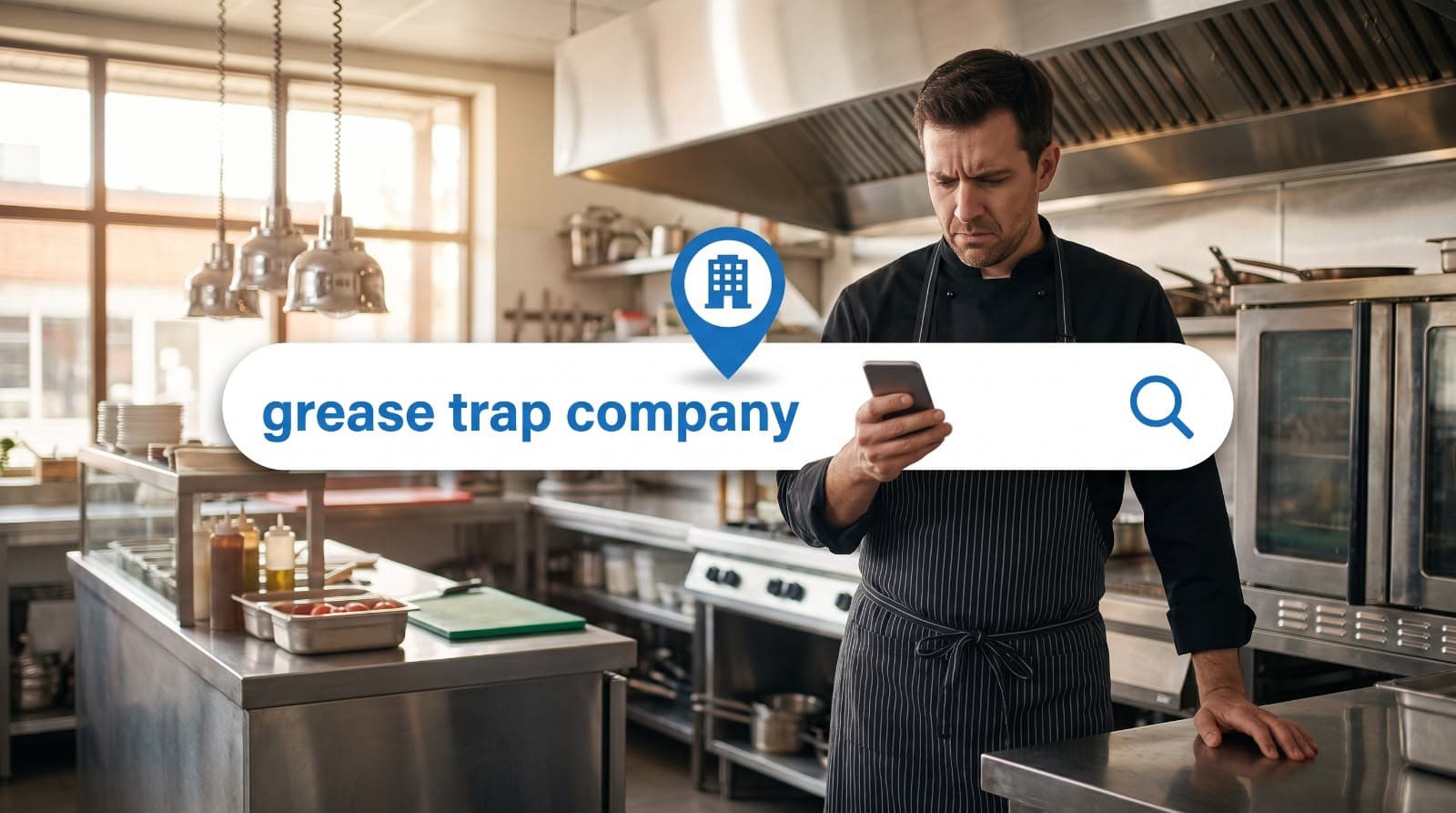
Open your phone. Go to Google. Search “grease trap cleaning” followed by your city name. Look at what shows up.
You'll see a map with three businesses listed underneath it. That's the Google Maps 3-pack. Those three businesses get the majority of calls from that search. Everyone below them, the organic results, the company websites, the directories, gets the leftovers.
If your company is in that 3-pack, your phone rings without spending a dollar on ads. If you're not, you're invisible for the search that matters most in your market.
This is the complete local SEO guide for grease trap companies. Not generic local SEO advice adapted from a dentist marketing blog. This is built specifically for the grease trap industry, the right categories, the right service listings, the right review strategy, the right service area page structure, and the right citation sources to get your company into that 3-pack and keep it there.
If you're running Google Ads using the strategies in our complete advertising and visibility guide, local SEO is the channel that compounds underneath those ads, generating free leads every month that increase over time while your ad spend stays flat.
Local SEO vs Google Ads for Grease Trap Companies
Before we get into the how, it's worth understanding where local SEO fits next to paid search. They're not competitors, they're two halves of the same system. Google Ads buys you leads today; local SEO builds an asset that keeps producing them for free.
| Local SEO | Google Ads |
|---|---|
| Free clicks | Paid clicks |
| Long-term asset | Immediate leads |
| Takes 3–6 months | Works immediately |
| Compounds over time | Stops when budget stops |
The smart play is to run both: use Google Ads for immediate lead flow while your local SEO matures, then let the free organic leads from a strong Google Business Profile take over the volume over time. For the paid side of that equation, see our Grease Trap Marketing Guide: Google Ads, SEO & AI Search.
How the Google Maps 3-Pack Actually Works
Google uses three factors to decide which businesses appear in the Maps 3-pack: relevance, distance, and prominence.
Relevance means how well your Google Business Profile matches what someone searched. If someone searches “grease trap cleaning Dallas” and your profile's primary category is “plumber” with no mention of grease trap services anywhere, Google doesn't consider you relevant, even if grease trap cleaning is 80% of your revenue.
Distance means how close your business is to the searcher or the location they specified. You can't change where your business is located, but you can influence how Google understands your service area, which we'll cover in the service area pages section.
Prominence means how well-known and trusted your business is online. This is driven by review count, review rating, review velocity (how consistently new reviews come in), website authority, citation consistency, and how active your Google Business Profile is. This is the factor you have the most control over, and it's where most grease trap companies are weakest.
The good news: Most grease trap companies have barely touched their Google Business Profile. The bar is low. A fully optimized GBP with a consistent review flow will outperform 90% of your competitors in local rankings because they simply haven't done the work.
The Complete Google Business Profile Optimization Checklist
This is not a general checklist. Every item below is calibrated for grease trap companies.
Business Name
Use your real, registered business name. Do not stuff keywords into it (“Dallas Grease Trap Cleaning Experts LLC”). Google penalizes keyword-stuffed names with suspensions. If your business name naturally contains “grease trap” you're fortunate, leave it as is. If not, don't fake it.
Primary CategoryMost Important
This is the single most important field on your entire profile. Set it to the closest available match for grease trap cleaning service. Google's category list changes periodically, so search for “grease trap” in the category selector and choose the most specific option available. If no exact match exists, “septic system service” or “drain cleaning service” are typically the closest alternatives.
Secondary Categories
Add every relevant secondary category: septic system service, drain cleaning service, plumber (if applicable), waste management service, sewer cleaning service. More categories means more searches where your profile can appear. Don't add irrelevant categories, only services you actually provide.
Services (Where Most Companies Leave Money on the Table)
This is where most grease trap companies leave money on the table. Google lets you list individual services on your profile with descriptions. List every service separately:
12 Services to List Individually
- Grease trap cleaning
- Grease trap pumping
- Grease interceptor cleaning
- Grease interceptor pumping
- FOG management
- Used cooking oil collection
- Emergency grease trap service
- Scheduled grease trap maintenance
- Grease trap inspection
- Commercial kitchen drain cleaning
- Restaurant grease trap service
- Recurring grease trap maintenance contracts
Write a 2-3 sentence description for each one that includes the service name and your service area.
Business Description (Use All 750 Characters)
You get 750 characters. Use all of them. Include what you do, who you serve, where you serve, how long you've been in business, certifications, and what makes you different. Don't waste characters on generic marketing language like “we're committed to excellence.” Every word should contain a service term, a location, or a trust signal.
Photos: Minimum 20 to Start
Upload a minimum of 20 photos. Google profiles with more photos get significantly more calls and direction requests than profiles with few or none.
What to Upload
- Trucks (branded with name + phone)
- Before-and-after photos (10+ pairs)
- Team in uniform or branded gear
- Certifications and licenses
- Equipment in action
- Office or shop exterior
- Working at commercial kitchens (with permission)
Upload Schedule
2–3 new photos every month
Google favors profiles with fresh, recent photo uploads over profiles with 50 photos all uploaded the same day two years ago.
GBP Posts & Q&A (Free Visibility Most Competitors Ignore)
95% of grease trap companies never post to their GBP. This is free visibility your competitors are handing you. Minimum two posts per month, weekly is better. Seed your Q&A section with 5-10 questions and answers, you can ask and answer your own questions, this is standard practice and Google encourages it.
Want the complete GBP optimization checklist?
Service area page templates, review request scripts, and a 90-day local SEO action calendar.
The Review Strategy That Actually Moves Rankings
Reviews are the single most influential factor in Maps ranking after your primary category. More reviews at a higher rating with consistent velocity beats a competitor with fewer reviews every time.
How Many Reviews Do You Need?
30+
Reviews
30+ reviews with a 4.5+ star rating puts you in competitive range.
Look at the top 3 companies in your market's 3-pack right now. Count their reviews. That's your baseline target. In most grease trap markets, top performers have 20–60 reviews.
How to Get Reviews Consistently
Build it into your service workflow. After every completed job, every single one, the customer receives a text message with a direct Google review link. Not an email three days later. A text message within 2-4 hours of job completion, while the experience is fresh.
Your Company
Sent 2h ago via SMS
Hi [name], thanks for choosing [your company] today. If you have a minute, we'd really appreciate a Google review, it helps other restaurant owners find us. g.page/review/...
If you do 20 jobs per month and 25% of customers leave a review, that's 5 new reviews per month, 60 per year. At that pace, you'll have more reviews than most competitors within 12 months.
Responding to Every Review (Within 48 Hours)
Respond to every review, positive and negative, within 48 hours. For positive reviews: thank them by name, mention the specific service, and reference the location. This adds keywords and location signals to your profile naturally. For negative reviews: respond professionally, acknowledge the issue, offer to make it right offline. Never argue publicly. A professional response to a negative review often impresses potential customers more than the review itself concerns them.
Review Velocity Matters
A company with 50 reviews that stopped getting new ones 6 months ago will be outranked by a company with 35 reviews that gets 4-5 new ones every month. Consistency signals an active, current business.
Service Area Pages: The SEO Multiplier Almost Nobody Uses
This is the single highest-ROI local SEO tactic for grease trap companies, and almost nobody in this industry does it.
If you service 8 cities, you need 8 individual pages on your website, one for each city. Not a single “Service Areas” page with a bulleted list of city names. That does almost nothing for rankings.
What Each Service Area Page Needs
Title Tag
Grease Trap Cleaning in [City] | [Your Company Name]
H1 Heading
Grease Trap Cleaning & Pumping in [City]
Word Count
400–600 words of unique, locally relevant content per page
Local Hook
Opening paragraph mentioning the city, types of commercial kitchens you serve (restaurants, hotels, food courts, schools), and your response time
Local Regulations
Section about local FOG regulations or compliance requirements specific to that municipality (research each one, they genuinely vary)
Local Proof
Testimonial from that area, or mention of specific restaurants, hotels, or facilities you've served there
Clear CTA
Phone number + link to quote form
⚠ Critical Warning
Each page must be genuinely different. The local regulations section, business types served, and opening paragraph all need to be unique across pages. Google penalizes duplicate content. Copy-pasting and swapping the city name won't rank, and could hurt your other pages.
Citation Building: Consistency Across the Web
A citation is any online mention of your business name, address, and phone number (NAP). Citations on trusted directories signal to Google that your business is real, established, and located where you say you are.
Where Grease Trap Companies Need Citations
Tier 1 · Essential
Do these first (Days 14–30)
- Google Business Profile
- Yelp
- Better Business Bureau (BBB)
- Facebook Business Page
- Apple Maps / Apple Business Connect
- Bing Places
Tier 2 · Important
Within 30 days
- Yellow Pages / YP.com
- Angi (formerly Angie's List)
- Thumbtack
- HomeAdvisor (commercial)
- Local Chamber of Commerce
- State / Provincial business directory
Tier 3 · Industry-Specific
Within 60 days
- NASSCO (Sewer Service Companies)
- NAWT (Wastewater Technicians)
- State environmental services directory
- Local restaurant association
- Trade publications (Pumper, Cleaner Magazine)
The Golden Rule: Consistency
Your business name, address, and phone number must be identical across every single citation. Not similar. Identical. “123 Main Street” on one listing and “123 Main St.” on another creates inconsistency that confuses Google. “ABC Grease Trap Service” on one and “ABC Grease Trap Services Inc.” on another is a mismatch.
Pick one version of your business name, one address format, and one phone number. Use those exact versions everywhere. If you've already got inconsistent citations floating around from years ago, clean them up, update every listing to match.
How to Check Your Current Local Rankings
Before you start optimizing, you need to know where you stand. Here's how to check:
Free, 5 Minutes
Manual Check (Incognito)
Open an incognito or private browser window on your phone. Search “grease trap cleaning [your city].” Do this for every city you service.
Why incognito: Regular Google searches are personalized. Incognito shows you what a stranger sees.
Ongoing Monitoring
Local Rank Tracking Tools
BrightLocal, Whitespark, or Local Falcon show your rankings across a grid of locations around your service area.
Your ranking changes based on the searcher's location, you might rank #1 in your home city but not 20 miles away.
The 30-60-90 Day Local SEO Plan
Days 1–7
Optimize GBP
Claim and fully optimize your Google Business Profile using the checklist. Every field, every service, every category, every photo.
Days 7–14
Q&A + Description + Photos
Seed your Q&A section with 10 questions. Write your 750-character business description. Upload your first batch of 20 photos.
Days 14–30
Reviews + Tier 1 Citations
Start your review request system. Text every customer after every job with a direct review link. Build Tier 1 citations.
Days 30–60
GBP Posts + Service Area Pages
Publish your first GBP post. Post weekly. Build service area pages for your top 3–5 highest-priority cities. Build Tier 2 citations.
Days 60–90
Scale + Monitor
Build service area pages for remaining cities. Build Tier 3 citations. Check rankings using incognito searches. Identify gaps and adjust.
By day 90, if you've executed this plan consistently, you should see measurable improvement in your Maps visibility, particularly in cities where you've built service area pages and where competitors haven't done any optimization at all.
For how local SEO fits into the complete marketing system alongside paid advertising and automation, read our complete digital marketing strategy for grease trap companies.

Two ways to take the next step
Frequently Asked Questions
It depends on your starting point and competition. A grease trap company with a fully optimized GBP, 30+ reviews, and consistent posting can start appearing in the 3-pack for their home city within 30 to 60 days. Expanding to surrounding cities through service area pages typically takes 60 to 120 days. Markets with fewer competitors see results faster.
Look at the top 3 companies currently in your market's 3-pack and match their count. In most grease trap markets, 30+ reviews with a 4.5+ star rating puts you in competitive range. But count alone isn't enough, Google also values review velocity (how consistently new reviews come in), so 5 new reviews per month beats 50 stale reviews.
Yes, and they're one of the most underused tactics in the grease trap industry. A dedicated page for each city you serve with unique content about local regulations and local customers tells Google you're relevant in that market. Most competitors have a single bulleted list of city names on one page, which does almost nothing for rankings.
If you have the time to execute the plan in this guide yourself, you can do it for free. If you don't have the time or want to move faster, a local SEO service can handle GBP optimization, citation building, review management, and service area page creation. Our retainers for grease trap companies start at $3,000 per month.
Fully optimize your Google Business Profile and start requesting reviews after every job. These two actions together have more impact on local rankings than anything else. Everything else in this guide, service area pages, citations, posts, Q&A, builds on that foundation.
Yes. Service area businesses like grease trap companies can rank in the Maps pack for cities they service without a physical office there. The key is service area pages on your website, citations that mention those cities, and reviews from customers in those cities. You won't rank as easily as a competitor with a physical location in that city, but in the grease trap industry most cities have minimal competition in local SEO.
About the Author
Parth Purohit · Founder, Copper Social
Parth is the founder of Copper Social (coppersocial.ca), the only digital marketing agency in USA, Canada, Australia and several other countries that works exclusively with grease trap and septic service companies. His work has helped a client scale to 3,000+ restaurant clients using the UNCLOGGED Growth Model, the most documented growth case study in the grease trap industry. Want to DIY? Get the Playbook. Want it built for you? Book the Audit.